
VOICE
Standards Initiative Beta
Programs sit in athletics departments, student affairs, academic units, IT, budgets range from nothing to seven figures, and two programs with the same number of players can be built completely differently. An administrator asked to fund a program has had little to compare it against, and a director asking for support has had little to point to.
The Standards Initiative was built on the idea that there is no single correct way to develop or run a collegiate esports program. The standards are not intended to be prescriptive, but rather show the unique fingerprint of a program using standardized language. The report shows a program in its own shape so its director has something concrete to bring to administrators when making the case for where their program is and what the program needs.
The VOICE Standards Initiative has four parts, the Esports Program Rubric and the survey that feeds it, the Program Finder, the individual Program Report, and the Collegiate Database. A program director completes one survey and all four are populated from it. Participation is free and open to any collegiate esports program in North America.
What is Included
The rubric defines seven core metrics of program development and four tiers within each. The survey is how a program is measured against it. It asks about structure, staffing, facilities, funding, competition, conduct policies, community work, and student outcomes, and it collects the public information that goes on the Program Finder. It takes about 20 minutes and should be completed by the program director or whoever runs the program day to day.
A free, public, live map of collegiate esports programs in North America. Each program that completes the survey gets a profile with general information about the institution and specifics about its esports program. Visitors can filter by state, conference, titles competed, scholarship availability, and more. Prospective students, parents, administrators, and other directors can use it to find programs and the map updates as surveys come in, verified by the VOICE Standards Team.
A private report sent to the email address entered in the survey. It scores the program on each of the seven core metrics, places each metric in a tier, S, A, B, or C, calculates an overall program tier, and gives growth recommendations based on where the program landed in each metric.
An anonymous, live aggregate of every program that has completed the survey. Participating programs use it to see where they sit in the full distribution as a benchmark. It updates every time a new survey is completed and no one can see which school gave which answer.
VOICE is a nonprofit creating a united voice for collegiate esports. Its work has been research, convening presidents and directors, and advocacy - the Standards Initiative extends that work to individual programs and conferences to help continue to raise the tide of collegiate esports.
Each of the seven core dimensions measures four core concepts.
1. Program Leadership & Institutional Integration. Leadership Structure, Institutional Integration, Decision-Making, and Program Stability & Planning.
2. Infrastructure. Facility Quality & Purpose, Infrastructure for Competition & Community, Competitive Equipment Standards, and Program Scalability.
3. Resources & Financial Support. Operational Budget Scope, Financial & Institutional Player Support, Staffing Support, and Revenue Generation & Sustainability.
4. Competitive Excellence. Competitive Success & Sustainability, Recruitment Strategy & Scope, Coaching Formality & Structure, and Talent Development & Program Continuity.
5. Program Conduct. Eligibility Transparency & Consistency, Competitive Standards Alignment, Conflict Resolution & Internal Accountability, and Program Conduct.
6. Community Engagement & Impact. Program Cultural Profile, Internal Campus Collaboration, External Influence & Impact, and Inclusive Climate & Belonging.
7. Student Success & Development. Holistic Student Support, Health & Wellness, Professional Skill Building & Experience, and Academic Integration.
Each metric is scored from the survey responses and placed in one of four tiers, S, A, B and C, with S the most developed. The seven metric tiers combine into an overall program tier. The scoring is quantitative and weighted. VOICE is not publishing the weights as publishing them would turn the survey into a test to be optimized rather than a description to be given honestly.
This is the first version of the rubric and VOICE intends to iterate and evolve it over time.
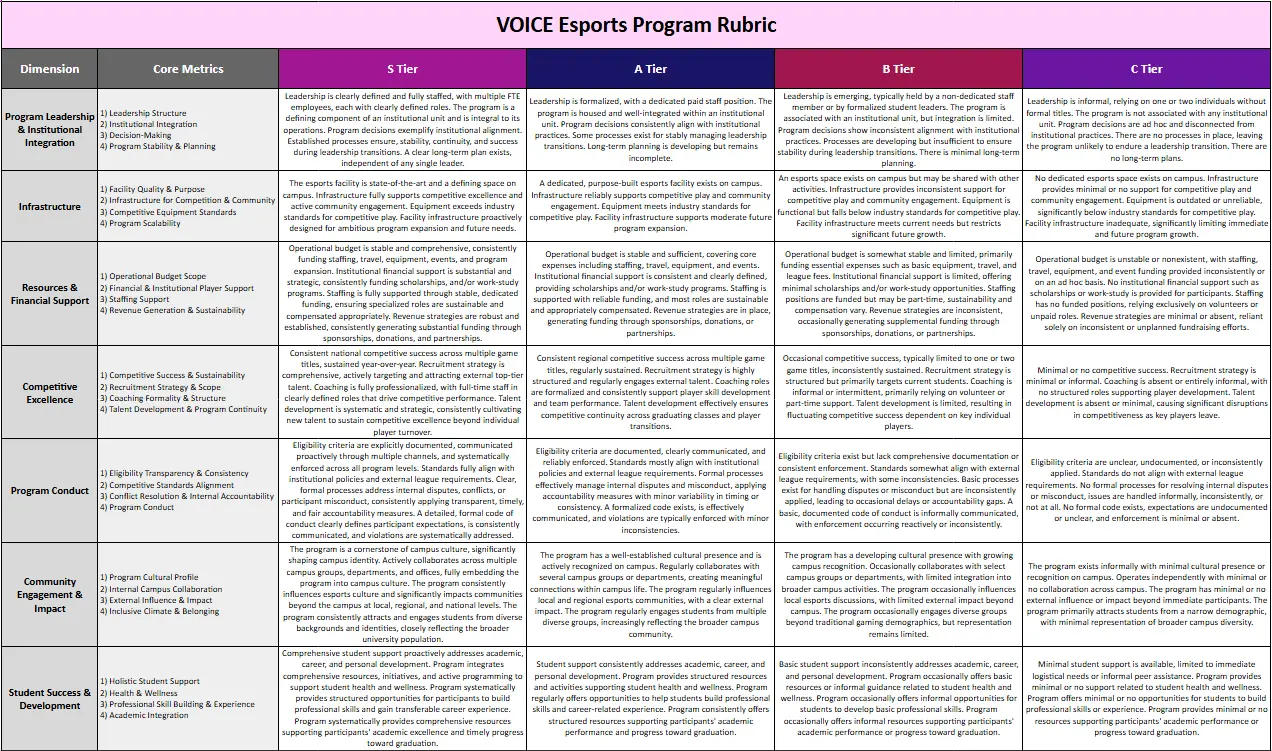
The rubric is not prescriptive. It does not say a program should sit in athletics, offer scholarships, or compete in a particular title. It describes what developed programs tend to have in place, in each of seven areas, and lets a program or school decide which areas matter for their institution.
VOICE’s intention is for the Program Report to be a tool used for internal advocacy and benchmarking. A director walking into a budget meeting with a tiered report and an anonymous benchmark has something an administrator can read and understand in two minutes. The same report works for strategic planning, for onboarding a new director, and for explaining to a president what the program is and where it is going.
The initiative is also meant to improve the whole field of collegiate esports. Every completed survey makes the aggregate more useful to every other program, and a shared vocabulary makes conversations between programs, conferences, and institutions easier.
2. Complete the survey in one sitting if you can. Have your program logo, photos, and basic facts ready, since they appear on your Program Finder profile. Answer honestly. The report is only useful if it describes the program you actually have.
3. Receive your Esports Program Report by email at the address you entered, along with a link to the Collegiate Database and Program Finder.
4. Share the report with your administration and colleagues.
Esports rubric assessment responses are fully private. They are used to calculate the Individual Program Report, which is sent with a unique link only to the email entered in the survey. They are then anonymized and aggregated into the Collegiate Database, which is available only to programs that have completed the survey and contains no institution names or other identifiers. Individual assessment responses are never published and never shown to anyone outside VOICE, except for partner conferences for which a program director can choose to share their rubric assessment with.
Respondent information (name, title, email) is used by VOICE for verification and contact and is not published, not shared, and not included in the aggregate.
VOICE does not sell data. VOICE does not share individual responses or individual reports with sponsors, publishers, or other institutions. VOICE uses the anonymized aggregate for its collegiate esports research, and published research reports distributions, never individual institutions.
The survey asks about the program, not about individual students. It does not collect student names or student-level data, other than an optional student nomination for the VOICE Student Advisory Council. That data is only used for that purpose.
Responses are stored in VOICE's official Airtable with access limited to the VOICE Standards Team. A director can update their program's information, remove the profile from the Program Finder, or withdraw the program's assessment data from the aggregate by emailing contact@voicecollegiate.org.
My program is a club, not varsity. Can we participate? Yes. The rubric describes development, and a club program lands where it lands. Its report will say so and the recommendations will be about the next step from there.
How long does it take? About 20 minutes.
Is there a cost? No.
Does my tier appear on the Program Finder? No. The public profile shows the school and program information you provide. Tiers appear only in your private report and, anonymously, in the Collegiate Database.
Can I see other programs' reports? No. You see your own report and the anonymous aggregate.
My institution's email domain is not .edu. Your request goes to a person for review, usually within a day. If you have not heard back, email contact@voicecollegiate.org.
Can I update my answers later? Yes. You may choose to fill out the survey again if information was submitted incorrectly. Broadly surveys will only be completed once per year.
Will the rubric change? Yes, though likely not drastically. This is the first version. VOICE will revise it as responses come in and will note changes on this page.
Why isn't the scoring methodology published? The scoring is weighted and publishing the weights would turn the survey into a test to be optimized rather than a description to be given honestly.
Do I need to be a VOICE member? No. VOICE membership is institutional through university presidents. The Standards Initiative is open to any collegiate esports program in North America.
Does completing the survey affect my conference standing? No. Participation is not required by any partner conference and has no bearing on eligibility or competition.
I'm not on Discord. How do I get help? Email contact@voicecollegiate.org!